Panasonic 6 Blinks and TV Model Checks Before Repair

Short answer: Six flashes alone do not identify a universal Panasonic TV fault or replacement part.
If your “panasonic 6” search concerns a television blinking six times, record the full model, light color, repeating pattern, and whether the screen starts. Panasonic televisions span different generations and designs, so a diagnosis copied from another model can lead to the wrong repair decision.
This guide addresses that six-blink TV interpretation of the short query. If the number came from a product label, menu, or search result instead, identify the full term first. The steps below focus on safe external checks, distinguishing the TV from its remote, and preparing useful evidence for model-specific support.
Identify What Panasonic 6 Refers To
A blink count needs a complete observation
Count the flashes in one repeating group and note the pause before the next group. Record which light is flashing and whether the television is trying to start. A brief response to a remote press is a different observation from a pattern that continues while nobody touches any controls.
A number needs context before it becomes a useful symptom. A panasonic 6-blink report should include the TV model and what happened immediately beforehand. Without those details, it is impossible to know whether another person’s instructions concern the same equipment or even the same kind of indicator behavior.
A short product query can mean something else
The phrase panasonic 6 can also be an incomplete product search. Terms such as panasonic 6 0, 7 panasonic, panasonic tv 8, or panasonic tv 800 do not by themselves establish a television fault. They may be fragments of names, numbers, or descriptions that need the original label or full query.
If the number appears in a model identifier, copy every letter and suffix rather than interpreting it as a blink count. If your issue concerns panasonic tv youtube tv, identify the app or service symptom separately. A streaming problem and a repeating standby-light pattern should not be combined into one diagnosis merely because both involve a Panasonic screen.
📘 Find the Right Guide: Panasonic TV Remote: Choose, Set Up and Replace It
Record the Indicator Pattern Before Changing Anything
Watch without pressing the remote
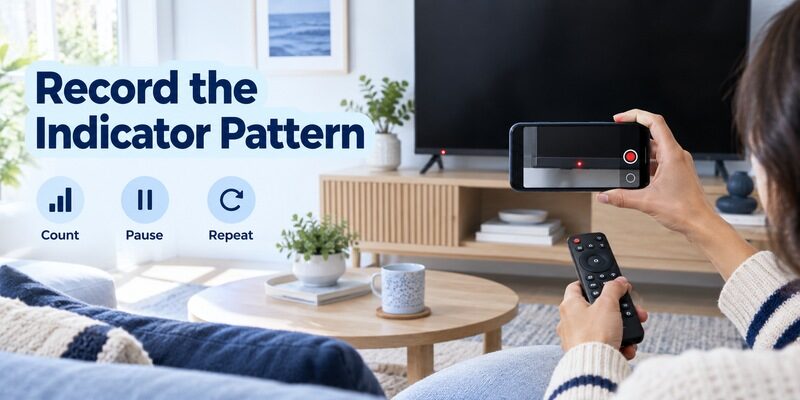
Place the remote on a clear surface and observe the television without sending commands. Note whether the pattern repeats by itself, begins after one power attempt, or appears only while a button is pressed. This separates an ongoing TV symptom from a control-related response.
For a panasonic 6-blink investigation, a short video can preserve the pattern more accurately than memory. Include the indicator and enough of the screen to show whether a picture appears. Avoid moving so close that the light leaves the frame or the camera exposure hides each flash.
If another person counted the flashes, ask them to describe how they separated one group from the next. A video can resolve a disagreement about whether a brief flash at startup belongs to the repeating cycle. Do not edit the clip so tightly that the beginning or pause disappears. Keeping several complete cycles gives support a fair view of the behavior instead of a single selected moment.
Note the beginning and end of each group
Count complete cycles rather than starting halfway through a sequence. Watch another group to confirm the count, and describe the pause in ordinary terms if precise timing is unavailable. Record whether the pattern stays the same or changes after the television attempts to start.
Keep observations separate from conclusions. Write “six red flashes followed by a pause, repeating with no picture” rather than naming a failed circuit board. A panasonic 6 report written this way gives support usable evidence without making a diagnosis that the observation alone cannot justify.
Match the Full TV Model and Indicator Guide
Find the exact television identity
Use an accessible product label, purchase record, or information screen if the TV remains usable. Copy the full identifier and sales region where known. Do not move a heavy or wall-mounted television alone just to read a hidden label; existing paperwork may provide the information safely.
For panasonic 6-blink advice, the model is more informative than screen size or the VIERA brand alone. Different generations can use different indicator meanings and service procedures. A guide for an older plasma television should not be assumed to diagnose a newer LCD or OLED model.
Check the document title, region, and model list before using a downloaded manual. A familiar screen size can appear in several unrelated series, and a search preview may omit the suffix that distinguishes them. Save the complete reference with the symptom notes so another person can verify it. That is particularly useful when a television has been moved, bought used, or separated from its original paperwork.
Read the indicator description for that model
Even ordinary light states are model-dependent. Panasonic’s TC-P60U50 manual, for example, describes its power indicator differently from newer model manuals. This is why a general statement that every Panasonic red light means the same thing is unreliable.
Use the matching operating instructions for normal indicator behavior. If they do not explain the repeating pattern, contact model-specific support. A panasonic 6 search result that names a component without identifying the exact television and diagnostic context is insufficient evidence for buying a part.
📘 Find the Right Guide: App for Panasonic TV Remote: VIERA and Platform Options
Separate No Power Standby and Other Visible States

| Observation | Useful next action | What remains unproven |
|---|---|---|
| No visible indicator and no response | Check accessible power connections and outlet | Whether an internal component has failed |
| Steady indicator with no picture | Consult model’s normal standby behavior | Whether the remote or TV is responsible |
| Repeating flashes with failed startup | Record the cycle and seek model-specific guidance | Exact fault and replacement part |
| Orange indicator on a supported OLED | Check the model’s maintenance or standby explanation | That the color alone represents a fault |
| Picture and TV menu both work | Identify the narrower source or app problem | That a general startup fault exists |
A black screen can have several contexts
Observe whether a television menu can be displayed and whether sound is present. A selected input with no active source can look different from a TV that repeatedly attempts to start and shuts down. Keep those observations separate instead of using “black screen” as a complete diagnosis.
In a panasonic 6-blink report, mention whether the flashes continue while the screen remains black or whether they stop once a picture appears. The sequence matters. A single description of the final black screen can omit the startup behavior that helps support choose the correct next question.
If the television remains fully usable, note which action preceded the indicator change. A screen entering standby after normal viewing presents a different sequence from one that never starts. Avoid forcing both observations into the same error label. The useful question is whether the behavior matches the normal operation described for that model, and whether a new symptom such as repeated shutdown is also present.
Maintenance should not be guessed from color alone
Panasonic’s Z85AGZ operating instructions describe orange indication during panel maintenance or certain active standby functions. That is a documented example for those OLED models, not a promise that every orange light is harmless. Check the actual TV’s instructions before interrupting a state that may be expected.
Do not turn a panasonic 6 query into a generic color diagnosis. Record the color, repetition, screen behavior, and model together. Those details let you distinguish a suspected fault from a normal process without assuming that one isolated clue answers the whole question.
💡 Discover Helpful Guides: Download the Panasonic TV Remote App: Complete Setup Guide
Complete the Accessible Power Checks
Check the supply without opening the TV
Confirm that the accessible power connection is secure and that the outlet is working, using an ordinary suitable device such as a lamp if appropriate. Inspect for obvious cable damage without exposing wiring or opening the television. If a connection is unsafe or damaged, stop using it and obtain suitable assistance.
Panasonic’s UK no-power guidance includes checking the outlet and trying the television’s own Power control. A remote cannot start a TV that has no usable power supply. For a panasonic 6-blink problem, record the result of these checks rather than assuming that another handset will change the symptom.
Before disconnecting anything, check whether the television is visibly installing an update or performing a documented maintenance process. If the state is unclear, consult the model guidance first. A generic power-cycle suggestion should not override an explicit on-screen instruction to keep power connected. Preserving that context prevents a routine troubleshooting step from interrupting another operation the TV was already carrying out.
Use a documented power cycle once
Where the model guidance permits an ordinary power cycle and no update or maintenance process is in progress, follow its specified procedure. Panasonic’s general UK guidance describes disconnecting mains power, waiting at least one to two minutes, then reconnecting and trying the TV’s Power button.
Do not repeat power cycling indefinitely if the same fault pattern returns. A panasonic 6-blink investigation benefits from noting whether that single documented check changed the behavior. Repeated restarts without a new observation add little useful information and can obscure the sequence you are trying to report.
If the TV starts normally afterward, test ordinary viewing and consult the model’s software guidance where relevant. Do not announce that an internal fault has been repaired merely because one restart succeeded. Record the original symptom and monitor whether it recurs under the same conditions.
💡 Discover Helpful Guides: Can You Factory Reset a Panasonic TV Without a Remote?
Check External Equipment Without Losing the Connection Map
Record the connected devices
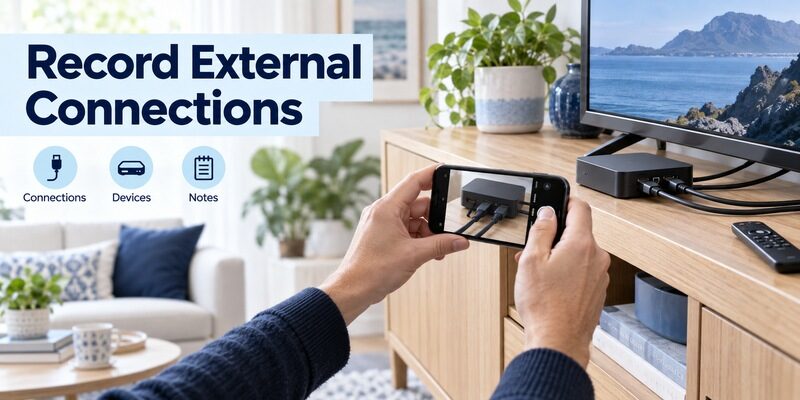
List the cable box, console, soundbar, USB device, or other equipment attached to the television. Note their sockets before disconnecting anything, and take a photograph if it will help restore the arrangement. Turn equipment off and follow the connection instructions in its manual.
Keep the test reversible. A panasonic 6-blink check should not leave the household with unlabelled cables and a second problem after the TV starts again. Identifying connections first also helps a service provider understand the complete setup rather than only the screen model.
When reconnecting equipment after a successful external test, use the recorded socket map and check one ordinary viewing task at a time. This keeps a swapped HDMI connection from masquerading as a new picture fault. If the original symptom returns only in a particular arrangement, describe the full combination and sequence to support. That evidence is stronger than declaring the last connected device defective without further assessment.
Compare with the TV isolated as directed
Panasonic’s no-power support suggests testing with external devices disconnected and only the power connection remaining. Apply that guidance according to the model’s instructions and safe access. Observe whether the same indicator pattern returns under the simplified setup.
If operation changes, reconnect equipment methodically as appropriate and note when the behavior returns. That observation can identify a relationship worth investigating, but it does not automatically prove which device or cable is defective. A panasonic 6 report should state the comparison accurately instead of jumping from correlation to a parts diagnosis.
If safe cable access requires moving a heavy screen or reaching an unsafe position, stop and obtain help. The purpose is a controlled external comparison, not dismantling the installation. A clear description of inaccessible connections is preferable to forcing the test under poor conditions.
💡 Discover Helpful Guides: Panasonic TV Remote Instructions for Buttons Menus and Daily Use
Distinguish the Remote from a Television Fault
Compare physical and remote power attempts
Use the television’s documented physical control and compare its response with a compatible remote. If the TV starts locally but ignores the handset, investigate remote batteries, compatibility, and receiver access. If both produce the same repeating failed-start pattern, focus on the television’s model-specific support route.
The guide covers the handset branch. A panasonic 6-blink pattern is not a universal remote pairing code. Entering the number into a universal handset or pressing a key six times does not follow from observing six indicator flashes.
Identify which light is blinking
A remote can have its own status light, and a connected box or soundbar may also show indicators. Record the physical location of the light rather than calling all of them “the Panasonic red light.” Include that detail in a video or support note so the observation is not misinterpreted.
If a light changes only while a remote key is held, release the key and watch again. A panasonic 6-blink description should be based on the television’s independent repeating behavior when that is the symptom. A controller’s transmission or setup indication belongs to the remote’s manual and needs its own interpretation.
Avoid Generic Blink Charts and Speculative Parts Orders

Different counts do not form one universal chart
A search for panasonic tv 10 blinks may describe a different model, generation, or diagnostic condition from a six-flash report. The same caution applies to discussions of eight or other counts. Do not assume that collecting those forum answers creates a valid chart for your television.
A fault indication can guide diagnosis without identifying one replaceable part. A panasonic 6-blink article that skips model verification and measurements may overstate what the observation establishes. The appropriate next step is model-specific assessment, not ordering a board because its name appears repeatedly in unrelated search results.
A parts listing can mention several television models and board revisions that look similar in photographs. That does not establish that the part addresses your symptom or belongs in your exact unit. Leave component identification to a qualified diagnosis. The most useful preparation for a service conversation is preserving the original model and observations, rather than accumulating speculative components based on incomplete search descriptions.
Keep service work separate from home checks
Television internals contain components and electrical hazards that ordinary remote troubleshooting does not address. Leave the cabinet closed. Do not bypass protection behavior, bridge contacts, disconnect internal boards, or attempt voltage tests based on a short online answer.
For panasonic 6 support, your useful evidence is the model, pattern, startup behavior, and accessible tests already performed. A technician can decide which additional diagnostics are appropriate. Buying speculative parts first can complicate that process and may leave you with components that do not match the actual fault.
💡 Discover Helpful Guides: Panasonic TV Remote Battery Types Replacement and Common Problems
Prepare a Clear Service Request

| Information to provide | Example of a useful description |
|---|---|
| Full TV model | Complete label identifier with regional suffix |
| Indicator | Location color count and repeating pause |
| Screen behavior | No picture brief startup image or normal menu |
| Control response | Result from TV button and compatible remote |
| External checks | Outlet power cycle and disconnected-device comparison |
| Timing | When the problem began and any relevant change |
Describe the sequence in ordinary language
Write what happens from the first Power attempt until the pattern repeats. Mention any sound, brief picture, or change in the indicator without interpreting it as a component failure. If the count is uncertain, say so and provide the video instead of forcing it into a panasonic 6 label.
A precise symptom report saves repeated questions. Support can use it to decide whether the next step is another consumer check, an inspection, or a service appointment. Keep the purchase information available if requested, but share personal details only through the appropriate support channel.
Ask what the next proposed check is intended to distinguish, and follow only guidance appropriate to your model and ability to access the equipment safely. If a requested observation cannot be made, explain why. A support process can then choose another route. There is no benefit in presenting an unperformed test as completed or giving a precise blink count when the video remains ambiguous.
Explain what has already been tried
List completed checks and their results separately. “Outlet works with a lamp; physical Power gives the same flashes; external devices disconnected with no change” is more useful than “tried everything.” Include any check you could not perform safely or because the model’s controls were inaccessible.
For a panasonic 6-blink case, do not repeat a risky or irrelevant test merely to make the list longer. The goal is reliable evidence. If the pattern changes, update the note so the service request reflects current observations rather than the first count remembered from earlier in the day.
💡 Discover Helpful Guides: Panasonic TV Remote Universal Compatibility and Setup Guide
Keep Control Available After Normal Operation Returns
If the television resumes stable operation, verify picture, sound, and source selection before restoring every optional setting. Keep the symptom record in case the behavior returns. A temporarily working screen does not establish the cause of the earlier fault. Follow any further model-specific manufacturer guidance provided.
Remote TV App can be a control backup on compatible networked televisions after normal operation is available. Check the requirements and test the intended screen. It can help when a handset is unavailable, but it cannot repair a protection shutdown or make an unresponsive television complete startup.
If the panasonic 6 problem is resolved through service, retain the service report and the correct remote information with the TV records. Avoid changing unrelated settings while verifying the repair. A familiar viewing sequence makes it easier to notice whether the original symptom has truly stopped recurring.
If the television is being assessed for repair cost, request a diagnosis and an explanation of the proposed work before authorizing a parts replacement. Keep that decision separate from the initial symptom count. The number of flashes may help the service process begin, but it does not establish the likely cost, availability of components, or whether repair is economical for the particular television.
Final Thoughts
Treat a panasonic 6-blink observation as a reason to identify the model and record the complete symptom, not as a universal parts diagnosis. Confirm the light location, repeating count, screen behavior, and response to documented external checks.
Keep the television closed and avoid generic board-replacement advice. If the fault pattern persists, provide the evidence to model-specific support. A careful observation record leads to a more useful next step than repeated resets or a parts order based only on the number six.
Download TV Remote App